Thursday, November 5, 2009

Portraying a Jersey Hero


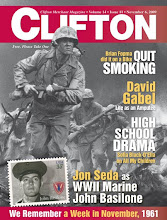
Jon Seda is Sgt. John Basilone in HBO’s upcoming miniseries "The Pacific"

Jon Seda assembled his water-cooled machine gun as his fellow Marines slept in two-man tents in the South Pacific. Tomorrow, they would travel a couple miles to meet the Japanese army stationed beyond the brush.

But this was Queensland in 2007, not Guadalcanal in 1942, the soldiers were actors and the bullets weren’t real.

Seda, who grew up in Clifton, underwent two weeks of boot camp training in Australia to prepare for his role portraying World War II hero John Basilone in the HBO miniseries, “The Pacific,” set to debut in March.

“Basilone was an expert with the machine guns, so I had to learn them in and out: how to put them together, how they worked,” said Seda. “It gave us a sense of what these men went through. These Marines were out there for years and they were starving. They were undermanned and they didn’t have enough weapons.”

The training was run by the project’s military advisor, Capt. Dale Dye, who also worked on “Band of Brothers” and Saving Private Ryan.

This was a life-changing role for Seda, who got his first taste of acting by soliciting Herald News subscriptions door-to-door in Clifton when he was a teenager.

“We’d show up to the house and ring the bell, and I’d start with, ‘Hey, listen, I’m just one order away from having a potential to get a full scholarship for college,” he remembered during a telephone conversation from Los Angeles. “You’d get some sweet old lady and she just couldn’t not give you the order. Meanwhile, it’s just getting you an extra five dollars on your paycheck.”

Growing up on Sylvan Ave., the son of a pastor at Bethel Church in Passaic had no desire to enter the entertainment business.

Flipping through the 1988 Clifton High School yearbook, you won’t find Seda’s picture on the drama club page. But turn to the sports section, and you can’t miss him—carrying the pigskin as a running back on the gridiron, pinning an opponent on the wrestling mat or posing as a shortstop in the baseball team photo.

“I grew up wanting to be a sports star,” he said, adding that some of his best memories are of playing pick-up baseball games at Weaselbrook Park.

But after graduation, Seda got a reality check when he realized he wasn’t going to be the next Bo Jackson.

However, that didn’t mean he was done with athletics. “I was just running some odd jobs and ran into some boxers,” he recalled.

“I grew up watching a lot of fights next to my dad [Hector], and I went to Lou Costello’s gym in Paterson and started working out there. I really loved it, so I made that my goal to be a professional boxer.”

Seda went on to train at Dominic Bufano’s gym in Jersey City and ascended the amateur ranks until he finished second at the 1989 New Jersey Golden Gloves.

After three-and-a-half years in the ring, the Clifton native’s mother, Dharma, began to worry about her son’s safety, and attempted to distract him by signing him up for acting classes in Manhattan.

“I did it just to please my mom,” said Seda, who has two brothers and three sisters. “Sometimes, I didn’t even show up, but the teacher kept telling me she saw something really natural inside of me and wanted me to continue a career in acting.”

The instructor got him an audition for Gladiator, a boxing film released in 1992 that also featured James Marshall, Cuba Gooding Jr., Robert Loggia and Brian Dennehy.

“I went to a ‘cattle call’ in New York, which is like a thousand people on line, and I ended up getting a co-staring role in the film,” he recalled.

Seda, who was unloading trucks at Caldor in West Paterson on Rt. 46, working at a gym and ushering at the former Clifton Theater at the intersection of Clifton and Main Aves. to pull in just $250 a week at the time, hit a big payday when he landed the role, getting paid $40,000.

“I blew all that money on a nice new car that I drove around Clifton,” he laughed. “I got a Dodge Stealth before anyone else had one.”

After discovering he could make a living as an actor, Seda quit the ring.

“The truth was there was no guarantee in boxing that I would’ve made it,” he explained. “Even the greatest fighter could get hurt in one fight and then it’s over.

“I miss boxing, I really do. But I think it made my mom a lot happier.”

Seda made the right choice as he went on to appear in Carlito’s Way (1993) with Al Pacino and Sean Penn, Boys on the Side (1995) with Whoopi Goldberg and Drew Barrymore, Twelve Monkeys (1995) with Bruce Willis, Selena (1997) with Jennifer Lopez, and Bad Boys II (2003) with Martin Lawrence and Will Smith.

“I learned a lot from those guys,” Seda said. “Pacino, I just remember being on set, standing in the back and just kind of watching him work to get into his character. I kind of took down notes in my head as to how he would prepare.”

The former Mustang has also played parts on television in Ghost Whisperer, CSI: Miami and an Oct. 19 episode of House, during which he played an edgy cop from New Jersey whose family had a history of heart disease.

Whenever Seda gets cast as a police officer, he remembers the pointers he picked up from spending time with his good friend, Joe Genchi, a retired Clifton Police detective.

In preparation for his 1997-99 role as Det. Paul Falsone on NBC’s Homicide: Life on the Street, Seda spent some time on the job with Genchi.

“I played this Italian no-holds-barred, hot-headed guy and that’s kind of how Joe is,” the actor joked.

“He took me around the precinct and he would let me look at actual homicide files.”

“It’s rewarding to see that it paid off,” said Genchi, who laughed at the notion of being hot-headed. “He applied what he learned here and it enhances his characters to make them more realistic.”

But Seda said his biggest role to date is depicting U.S. Marine Corps Gunnery Sgt. John ‘Manila’ Basilone in a 10-part HBO miniseries from the creators of “Band of Brothers.”

“For me, portraying John Basilone for his home state ... I just felt an added responsibility on this one,” said Seda, who noted that the soldier’s death scene was ironically filmed on Feb. 19 this year.

“I had a script sent to me and I just really felt connected, and I was definitely meant to play this role.”

Seda auditioned in front of the miniseries’ producers, which included Steven Spielberg and Tom Hanks.

“I was nervous, but it was more of nervous energy,” he said. “If you don’t tune them out, then you’re a nervous wreck because they’re icons.”

“The Pacific,” which also follows the lives of two other U.S. Marines, Robert Leckie and Eugene Sledge, began shooting in August 2007 and reportedly had the largest budget ever for HBO at $250 million.

“It’s just such an important story to be told,” said Seda, who moved from Maclean Rd. in Clifton to Los Angeles two-and-a-half years ago.

“It’s a voice for all those Marines that never got to let those at home know what they were really going through, and how heroic they were to help give us that freedom that we have and cherish.”
The miniseries is also a big stepping stone in the actor’s career.

“I think I’m at a point now where I don’t want to just do anything,” he said. “I want to have stuff where I’m able to really bring out the best in the characters.

“I’d also like to produce films and have my own production company, so I can bring some stuff back to Clifton.”

Tuesday, September 8, 2009

Landing on the Hudson


Clifton native Glenn Carlson was aboard Flight 1549 Story by Jordan Schwartz

Glenn Carlson made his way down the aisle of US Airways Flight 1549 and took a seat in 6B. He removed his shoes, put on his eye shades, inserted his ear plugs and waited for the bell that would allow him to unbuckle his belt and recline his seat.

That bell never rung.

Just 90 seconds after takeoff, Carlson heard a loud bang and threw his arms out, hitting the two passengers sitting next to him.

The Clifton native smelled something burning and figured the plane would just return to LaGuardia Airport. That was, until the pilot came on the loudspeaker.

“This is your captain,” he said. “Brace for impact.”

The flight attendants repeated the warning: “Brace! Brace! Head down! Stay down!”

But no matter how hard he tried, Carlson couldn’t will his body to get down. Instead, he looked out the window to his right and locked eyes for a moment with another passenger sitting in 6E.

“I saw buildings on both sides,” Carlson remembered. “I was afraid we were going into the bay.”

But the 47-year-old never considered the worst.

“I didn’t believe that was a day for me to die,” he said.

Neither did Captain Chesley “Sully” Sullenberger.

The heroic pilot miraculously landed the Airbus A320 in the Hudson River, just minutes after it
struck a flock of Canadian geese and lost nearly all thrust from both engines.

“It was very smooth, like a regular landing,” Carlson recalled. “What scared me most was getting out of the plane. I thought we would sink.”

“The Wing was Packed”

The 150 passengers aboard Flight 1549 were quiet when the plane came to a rest in the Hudson. But the silence didn’t last for long.

“I looked to my right and the guy on the aisle was gone,” said Carlson. “The guy by the window was like, ‘Let’s go!’”

The married father of three boys headed for the exit by the wing, stopping momentarily to grab a seat cushion to use as a flotation device.

“The wing was packed,” he explained and so he searched for another way out.

Carlson noticed a man motioning to him from the front exit. Fellow passenger Douglas Shrift was notifying him of an easier way out. So, the CHS ’79 grad ran up the aisle and slid into a life raft.

“People were yelling for a knife to cut the raft loose,” he remembered.

Carlson said he never really had time to stop and consider the incredible event he was living through; he just kept thinking one step ahead.

“First was land the plane, then get off, then start looking for boats.”

A New York Waterway ferry called the Thomas Jefferson plucked Carlson and 58 other passengers from the river that day and transported them back to a pier in Manhattan.

“When we arrived, there were a bunch of cameras and microphones in our faces, but a guy in a suit pushed them away,” said Carlson. “I thought he was a police officer but he turned out to be another guy on the plane named John Howell. His brother died on September 11.”

As cops corralled the passengers to get everyone’s information, New York City Mayor Michael Bloomberg arrived on the scene.

Carlson shook his hand and the two got to talking about North Carolina universities. Bloomberg said his niece was headed to Duke, but the Charlotte resident told the mayor he was a UNC man.
Carlson asked Bloomberg if he could have his cufflinks to prove he met the billionaire, but the mayor gave him a Big Apple pin instead and jokingly instructed him not to sell it on eBay.

Since he dropped his Blackberry during his escape from the plane, Carlson was forced to borrow another passenger’s phone to call his wife, Ann Marie Zimmerman (CHS ’85).

Even though she was home, Ann Marie didn’t answer the call because she didn’t recognize the number.

“Muff,” Glenn called his muffin on the machine, “I think I’ll try your cell...”

Ann Marie picked up and with all the commotion going on in the background, she thought he missed his flight and was at a bar.

“I was in a plane crash,” he told her before quickly adding that he and the rest of the passengers were alright.

“If he’s fine and everybody’s fine, what kind of plane crash is this?” she remembered thinking.
Ann Marie turned on the television, saw the plane in the river and realized what was going on.
She then called the rest of the family to get them caught up.

Glenn, meanwhile, waited for his younger brother, Craig, to pick him up and drive him back to their parent’s house on Kenter Pl. in Clifton.

The next day, Carlson’s company, DemandTec, chartered him a private jet back to Charlotte, where he and his family have lived since June 2003.

The consultant was a little scared to go up in a plane again, so his mother, Geri, gave him some Clifton Merchant Magazines to read on the flight.

Carlson’s nerves weren’t eased any by the fact that he was the only passenger aboard the six-seater, and so he decided to fill the nearly two-hour flight by writing his wife a letter about all he had experienced on January 15, 2009.

Thanking Sully

Glenn Carlson wasn’t even supposed to be on Flight 1549.

In New York for business, he was scheduled to return home to Charlotte at 7 pm. But when the meeting finished early, he phoned his travel agent to book a 2:45 departure.

By the time the William Paterson graduate reached the Midtown Tunnel, his agent called him back to say the earlier flight was booked and so he got him a ticket on a 5 pm.

Already en route to LaGuardia, Carlson figured he’d get on the standby list for the 2:45 and see what would happen.

Of course, his name was called for the earliest flight, and so he texted his wife to let her know he’d be home by 5 o’clock.

Carlson didn’t meet his prediction but his entire family was overjoyed when he finally made it back the next day.

The dad was greeted at the airport by Ann Marie and their three sons: Sean, 14, Brett, 12, and Ryan, 9.

Weeks later, Glenn and his wife joined about 50 other passengers at a reunion in Charlotte. Captain Sullenberger was in attendance and Carlson thanked him for his heroic actions, jokingly adding, “I was the one knocking on the door to ask if you needed any help.”

On a recent visit to New York, the School 9 alum took his family on a boat ride to the crash site in the Hudson River.

The Michael Murphy is owned by a Rutherford man named Scott Koen, whom Carlson met on Facebook. Koen rescued six people on that fateful day and had commemorative medallions made to distribute to the passengers.

One side of the coin says “Miracle on the Hudson, On a Wing and a Prayer” and the other has a
picture of the flight path. Carlson had his name and seat number engraved on his medallion before pitching it into the river where he came so close to death earlier this year.

Thursday, August 6, 2009

Clifton's Hot Dog King


Pat “From Moonachie” Philbin is really from Clifton by Jordan Schwartz

Pat Philbin shoves hot dogs in his face like a perfect gentleman.

He meticulously dips frankfurter after frankfurter into the yellow Nathan’s cups filled with water in front of him, soaking the buns to allow for an easier transition from hand to mouth to esophagus to ever expanding stomach.

“I changed it up this year,” said the 1981 Clifton High School grad. “Less drinking and more dunking.”

The formula worked as Philbin consumed a personal best 32 franks in 10 minutes at a Nathan’s Hot Dog Eating Contest qualifier held outside Citi Field in Queens on a rainy June 20.

But it wasn’t enough as the 45-year-old was out-eaten by his nemesis, Eric “Badlands” Booker, who put down 40 hot dogs and buns, or HDBs as they’re known in the world of competitive eating.

After the qualifier was over, Booker’s chest was covered with soggy bits of meat and bread, leaving Philbin to take some solace in the fact that he was at least clean.

“Look how neat I am,” he joked.

But the loss snapped the Clifton native’s streak of four straight appearances at the Fourth of July Coney Island finals, an event broadcast live across the country on ESPN.

“The competition is getting better,” he said. “It used to be 20, or ‘doing the deuce,’ was the big benchmark, but there are more and more people doing way over 20.”

Philbin was urged to become a competitive eater after a November 2004 appearance on The Opie & Anthony Show, a popular talk program on Sirius XM Satellite Radio.

The longtime fan won a non-alcoholic eggnog drinking contest by downing 70 double shots of the beverage, doubling his closest competitor.

The following summer, Philbin, who grew up on Macarthur Dr. and Swift Ct., took part in his first Nathan’s contest. On July 4, 2005, he ate 20 hot dogs in 12 minutes, good enough for 12th place.

A year later, Philbin finished 10th by inhaling 23 HDBs. He beat out Erik “The Red” Denmark and Crazy Legs Conti, so the former Mustang decided it was time to get a moniker of his own.
He became “Pat From Moonachie,” after the small Bergen County town in which he’s lived since 1993.

Philbin, a self-employed courier, resides in a 30-by-12-foot trailer by Teterboro Airport.

“It was one of the few places that took animals and I have a dog and three cats,” he explained. “I tell people I have skid marks on the roof from planes landing.”

As Pat became a reoccurring guest on Opie & Anthony, his humble residence turned into a running joke on the show. The hosts even recorded their own version of “Cribs” at his home.
But Philbin’s relationship with the radio program got him in trouble with the International Federation of Competitive Eating.

Yes, that really exists.

During the 2006 Eggnog Drinking Challenge, the former Clifton wrestler vomited into the mouth of a show intern and the subsequent “Baby Bird” video got him barred from the I.F.O.C.E. for “conduct unbecoming of an eater.”

With the help of protests by O&A’s most dedicated fans, affectionately known as ‘pests,’ Philbin was reinstated on Dec. 6, 2006.

He went on to eat 24 hot dogs at the 2007 Nathan’s contest and 20 at the 2008 event, which was shortened to 10 minutes. “They don’t want anyone exploding,” explained the 16th ranked eater in the world.

Philbin, who weighs 310 pounds, developed diabetes when he was 27. He said he watches what he eats other than in contests and has actually dropped 40 pounds from his high of 350.

The Nathan’s time adjustment hasn’t slowed down the competitors, though. Joey Chestnut consumed a world record 68 HDBs to win his third straight mustard-yellow belt this past July 4, beating out six-time champ Takeru Kobayashi, who ate 64.5.

Chestnut took home $10,000 for his effort, but Philbin has only made about a couple thousand dollars in his entire career as a competitive eater. Nevertheless, he says he does it for the little bit of notoriety rather than the money.

Pat From Moonachie has become somewhat of a minor celebrity from The Opie & Anthony Show as well.

“It’s pretty cool,” he said. “When I go around O&A events, I’m like a rock star.”

Philbin has even gotten invited out to Anthony Cumia’s mansion on Long Island to co-host his Web casts. “The first floor is really nice and respectable and then the basement has a studio with a green screen,” he explained. “When I leave, I say ‘I’m going back to the trailer now.’ I could fit it in his living room.”

Philbin has also done delivery work for the show’s other host, Greg “Opie” Hughes.

The Delawanna native has been a courier for 20 years. After graduating CHS, he was a bouncer at Connections before going to work for his step-father’s printing business, Charles D. Ingraham and Sons.

Philbin’s biological father left the family when Pat was just one year old.

“He lives in Wayne,” said the ’81 grad. “I looked him up once and he said, ‘Hello,’ and I just hung up. I wouldn’t make the effort. My attitude is if he doesn’t want to meet me then I don’t want to meet him.”

Philbin said his older brothers served as father figures growing up because they were 10 years older than he was. His half brother, Bill Ingraham, used to coach the Clifton Tigers and was on the Clifton Phillies, while Pat was his bat boy.

Philbin attended Schools 16 and 8 and Christopher Columbus before entering CHS.
In ninth grade, he lettered in football, track and wrestling. At 240 pounds, Philbin won County and District titles.

He got his start in the sport grappling on the front lawn with Dave Szott, who went on to play guard for the New York Jets.

Philbin returns to his hometown once in a while to visit his mechanic or grab a bagel from the shop on Piaget Ave. across from CCMS.

“It’s out of habit because I used to go there after football practice at Clifton Stadium all the time,” he said, adding that he also frequents Rutt’s Hut a couple times a month.

“Don’t tell Nathans, though!”

Thursday, April 30, 2009

A Legacy of Service


Passaic County Council celebrates 25 years on May 25 by Jordan Schwartz

The Passaic County Council on Alcoholism and Drug Abuse Prevention celebrates its 25th anniversary on May 25, and it may never have been more needed than right now.

During these difficult economic times, more and more people are turning to drugs and alcohol to escape their problems, but the Council can help.

Located in the Clifton Municipal Complex at 880 Clifton Ave., the Council is a private, not-for-profit organization that provides information, assessment and referral.

It offers alcohol, tobacco and other drug education, an Employee Assistance Program, public policy and legislative information, and National Intervention Network Services.

“The supply of drugs is always going to be there,” said Executive Director Father Alan F. Savitt, 61, a Catholic priest from the Paterson Diocese. “The change is going to come if you can impact the demand.”

Savitt believes his group can do that with informational programs such as the Underage Drinking Initiative and the Strengthening Families Program (more information at passaiccountycouncil.org).

Drug and alcohol addiction problems are often hereditary—something the executive director knows all too well.

“I was personally affected by growing up in an alcoholic family system,” said the lifelong Cliftonite. “You saw all the consequences of alcoholism and addiction.” Savitt’s father died at the age of 53 from liver cancer as a result of his heavy drinking. The priest’s younger brother passed away at age 51 for the same reason.

Their mother’s life ended in November 1996 due to Stage 4 Lymphoma, but Savitt thinks the disease was caused by her co-dependency. “It’s just as insidious and serious as other addictions,” Savitt said of the issues related to alcoholism.

Savitt himself began drinking when he was just eight years old, but was able to kick the habit at 28. Less than a decade later, the priest helped found the Council and began what would be his avocation in a 200 sq. ft. trailer near City Hall.

After renovating a historic building on the property, the Council moved to its permanent headquarters and Sister Pauline Kuntne joined as Director of Prevention Services.

“We’re the only Council with a Catholic priest and a nun on the staff and we’re both recovering addicts,” said Savitt. “We’ve been given a gift that we want to give away.”

Since its beginnings in 1984, the non-profit has faced several challenges. Back then, many in Clifton believed drugs and alcohol were problems in just neighboring Passaic and Paterson and didn’t think a center needed to be located in town. After some convincing, the Council was opened, but it has struggled with getting financial support ever since.

The Council receives grant money from the State Department of Health, as well as corporate donations, but those have decreased recently due to the recession.

County funding dried up in 1999, and as a result, the Council was almost forced to close.
“There has been a progressive need for services which we’re stretched to meet because of funding,” said Savitt. “Some Councils like down in Monmouth County, have 15 staff members and a $1.5 million budget. Ours is around $400,000.”

The executive director would like to see that total doubled in order to meet pressing needs, among the most needed is restoring the exterior of the century-old building.

But the focus right now is preparing for the 25th anniversary which is scheduled for 7 to 9 pm on May 19 at the Brownstone, 351 West Broadway, Paterson. To pull it all together, Savitt is knocking on a lot of doors and going through his old rolodex to bring in some heavy hitters. For instance, the keynote speaker will be WABC-TV Sports Director and Anchor Scott Clark.

Others scheduled to attend include Gerard McAleer, Drug Enforcement Administration, New Jersey Division Special Agent in Charge; Dr. Robert Zlotnick, President, New Jersey Prevention Network; and Robert J. Lindsey, President and CEO, National Council on Alcoholism and Drug Dependence.

Tickets are a $50 donation and checks should be made payable to Passaic County Council. Reserve by May 15 by calling Savitt at 973-473-3366 ext. 105.

People from all walks of life are invited to support the event, because everyone can be affected by drugs and drinking. “Alcoholism and other addictions are equal opportunity, non-discriminatory diseases,” concluded Savitt.

Friday, January 16, 2009

Fully Leased and Going Green


by Jordan Schwartz

These might be difficult economic times, but no one told L. Robert Lieb and his tenants at Mountain Development Corp.

The Chair and CEO of the realty firm welcomed three new companies to the Mountain Technology Center at 100 Delawanna Ave. during a press conference on Dec. 17.

MDC bought the seven-story building in 2001, and with the addition of Telx, Automated Logic Corporation and EK Success, the former Givaudan headquarters, which is visible from Rt. 3 and just off Rt. 21, is now at full capacity.

MDC President Michael A. Seeve said the company purchased the building for three reasons: its proximity to a New Jersey Transit train stop, its excellent infrastructure with dense floors and high ceilings, and a love for investing in Passaic County.

“This region has real resilience and depth,” he said.

These are exactly the reasons why Automated Logic New York/New Jersey President Frank Del Vecchio decided to consolidate his two locations on Broad St. and in Lincoln Park into 100 Delawanna Ave.

“It’s a great centrally-located office for our clients and it provides our employees with a great commuting opportunity,” said the 1978 CHS grad, who added that seven of his employees are also alumni.

And new companies mean new jobs. Automated Logic and fellow Clifton company, EK Success, expect to relocate a total of about 200 workers to the Center.

Rose Kilmovich, Vice President of Product Development and Engineering for Telx, said the proximity to New York is a plus.

“We have two very large data centers there,” she said, “and there’s very good data center space on the second and third floors here.”

Telx is on a role. The interconnection company is picking up 24,000 sq. ft. of co-location space in order to offer customers the ability to connect to more than 400 firms all with just one point of connection between the networks.

This was the New York-based company’s fifth acquisition of 2008, totaling more than 70,000 square feet of new space and increasing the firm’s footprint by more than 20 percent. Telx plans to build out its space at the Center which should lead to the creation of a number of construction jobs.

PSE&G is working closely with the developer because data centers depend highly on electric service.

“We have a very reliable system so it’s a nice fit,” said William P. Steffens, Vice President of PSEG SiteFinders LLC. “The proximity to our network and another major data center in Nutley really helps.”

The utility will increase the amount of electricity brought into the building by 100 percent to power the servers, and the heating, ventilation and air-conditioning systems necessary to cool down the hardware.

The relocation of these three companies to the Mountain Technology Center is a step forward not only for Clifton, but for Passaic County and the entire state as well.

“It’s extremely important for the county,” said Deborah Hoffman, Director of the Passaic County Department of Economic Development. “Michael Seeve and his team have been working tirelessly to move companies in. These are very high-tech companies.”

The state now has six million square feet of data services and co-location space, with an investment of about $1,000 per square-foot to build.

“New Jersey is becoming business friendly,” said Caren S. Franzini, CEO of the NJ Economic Development Authority, adding that these three companies will bring 280 jobs to the Center.
But in the end, it’s really Clifton that benefits the most.

“It’s a nice Christmas present,” said Mayor James Anzaldi.

Thursday, January 15, 2009

Fette Adds to the Portfolio

Infiniti Brand Joins Ford and Kia on the Showroom Floor
by Joe Hawrylko

Fette Ford, the longtime Clifton icon on Rt. 46 East, is expanding its lineup to include the luxury line up of Infiniti vehicles.

“We now have three lines that satisfy every segment of the market,” said John Fette, owner of the 56-year-old business founded by his grandfather. “This gives us a chance to put our truck owners, many of whom are business owners, into a luxury car,” he continued. “There are customers that wanted to move up to a luxury line that Ford was not filling at the time.”

In addition to the six Infiniti vehicles, Fette also offers a choice of eight Kia products and up to 17 Ford vehicles, which includes the popular Ford light and heavy duty trucks
The Infiniti brand is a luxury division of Nissan. Pricing starts at $33,000 for the lowest end model and works steadily up. Kia is the economy car, with some models starting as low as $12,000. Ford fills out the middle of the pack.

With the recession looming, this might seem like a peculiar time to purchase a dealership and expand the services offered; however, Fette said the investment allows him to better serve his customers.

“After we added Infiniti, I watched as the customers queued up to our service department,” he recalled. “It was then that I realized that these are our customers. They know us and we knew them. Some were former Ford customers, but when they wanted to go luxury, they evolved and went to Infiniti. Now, we can address all levels of the driving public. I think it helps our whole operation, in everything from service to customer satisfaction,” he continued. “Our people are trained in every aspect, from sales and warranties to service.”

The move makes Fette one of 180 Infiniti dealers nationwide, and the exclusive dealer for Passaic and Essex counties. However, Fette said Ford is still the flagship.

“Ford remains the best domestic franchise in the economy,” he stated. “From the SUVs, to cross overs, and commercial trucks especially. Yes, time are tough but we Americans will always drive cars. And with the options we offer, I believe the Fette family will be able to meet their needs for generations to come.”

Renovation and Relocation

Anthony Marinaro renovates a former Kuller Rd. eyesore
by Joe Hawrylko

These days, the real estate market is anything but a sure bet. But Anthony Marinaro defied the odds and his investment in his hometown is already starting to pay dividends.

Marinaro, a 1975 graduate of the now-defunct Paul VI High School, is nearly done with renovations to the building that he purchased at 310 Kuller Rd. The 30,000 sq. ft. facility was the first venture into speculative real estate for Marinaro, President of AJM Contractors, Inc.

This past September, Marinaro entered into a 25 year lease for 26,000 sq. ft. of the property with ImageFirst, an industrial health care laundry specialist with locations throughout the nation.

Sean Crimmins, assistant general manager for ImageFirst’s Clifton location, said the Pennsylvania-based firm selected the Kuller Rd. site because of the availability of local labor, quality water and sewage services and the positive business environment the City of Clifton and Passaic County offers.

Relocating from Essex County, ImageFirst brings roughly 40 employees who will provide laundry services to local health facilities. Crimmins said the company focuses its services to doctors offices and medical centers, such as those on the Clifton Ave. extension. ImageFirst also brings about 10 sales and clerical people to Clifton. The renovations to the laundry area, which are still in progress, are turning this facility into green. Crimmins said one of the environmentally-friendly features is a water reclamation system, allowing ImageFirst to recycle what it uses. There’s also energy efficient lighting, insulation, boilers and state-of-the-art machinery.

While interior and facade renovations are complete, Marinaro said come spring he will put the finals touches on the property with the planting of trees, landscaping, fencing and signage.

Marinaro is using 4,000 sq. ft. of the building for his offices but still maintains his original location in Passaic for the yard and equipment storage.

He added that the renovation and leasing went so well that he recently purchased on spec another 23,000 sq. ft. industrial property in Carlstadt, which Marinaro is renovating. “While contracting is a risky business, I feel comfortable and confident in investing in commercial and industrial real estate,” he explained.

Garret Pointe Entrance Nixed

by Jordan Schwartz

After nearly two years of hearings, the Clifton Zoning Board of Adjustment unanimously voted to deny Garret Pointe Associates’ variance application. Their plan was to convert Paxton St. off of Mountain Park Rd. in Clifton into an entranceway to service a proposed group of 128 residential units on a nine-acre quarry parcel (above) in Woodland Park, formerly West Paterson.

“The conditions up there, both inside and outside the grounds were really unsafe,” said board alternate Gerard Scorziello, who voted in place of regular member Steven Abill, who had missed a few meetings on the matter. “It was a poorly put together plan and it wasn’t consistent with the Clifton master plan.”

A use variance was needed because Garret Pointe wanted to use a piece of property in a residential zone as a driveway.

Board members had asked the applicant if it was possible to build an entranceway elsewhere, like through the Bank of New York property that sits behind the quarry in which the development would be located, but Garret Pointe’s attorney, Frank Carlet, said that would be impossible.

“If you have a parachute you could do it, but how do you get back up?” he quipped. “We have no right to go by the bank. You couldn’t build a ramp safely [because of the 50-foot quarry wall], and even if you could, you’d be building it through other people’s property.”

But Carlet said he wasn’t surprised by the Clifton board’s rejection. “When we filed this application, we had no real hope that the city would approve it,” he said. “We prepared our legal case with the anticipation that it would go to court.”

Carlet plans to appeal the ruling to the Passaic County Superior Court in Paterson.

This case, which started way back in 2001, has already made its way through the legal system in West Paterson, but until this latest decision is possibly overturned, one local resident will continue to enjoy what he believes to be a major victory.

“This application would’ve destroyed the mountain,” said Joe Holzli of Mountainside Terrace. “The steep slope ordinance was approved by the City Council back in the ’70s to protect the mountain. They would’ve taken down the cliff face and changed the ridge line.

“All the buildings are in West Paterson, so Clifton gets nothing out of this except trouble.”

Plenty of Banking Options


by Jordan Schwartz

If you looked at only the banks in Clifton, you wouldn’t think the industry just completed one of its worst years in American history. Three new banks are scheduled to open in the city during the first half of 2009.

The first Provident Bank in Passaic County is on its way to the corner of Lexington and East Clifton Aves. Originally scheduled to open last year, construction has been delayed due to soil conditions, permitting snags and engineering issues at the municipal and county levels. The branch should now open sometime during the early portion of the second quarter.

“Better to get it done right than to get it done quickly,” said Ken Wagner, Senior Vice President of Investor Relations.

The 3,500 sq. ft. bank will be oddly shaped due to its location in an irregular lot, but it will be a full-service branch with three drive-thru lanes, including one with an ATM.

Provident has been in negotiations with Clifton since the early stages of 2006 when the city’s economic development director and a lifelong customer, Harry Swanson, recruited the bank.

“As we worked through it and saw the plan for that neighborhood, it looked like a real opportunity to distinguish ourselves instead of opening on crowded Main and Clifton Aves. where consumers already have a lot of choices,” said Wagner.

“This allowed us to be a little more creative with the design. We also liked being near Rt. 46 and in a part of town that was earmarked as a special improvement district.”

Swanson said Provident is really turning out to be “the anchor of Lakeview.”

Meanwhile, Clifton Savings is renovating its location at 646 Van Houten Ave. to include two drive-thru lanes (one with an ATM) and a larger lobby to better accommodate customers and provide more privacy. Work began this fall and is expected to be completed by next month.

Clifton Savings, which opened in 1928, has six branches in the city. They include the original location in Botany Village, two on Van Houten Ave. and ones on Clifton Ave., Lakeview Ave. and Valley Rd. The bank also has branches in Wallington and Wayne, and two in Garfield.

The third bank under construction is Federal Ft. Lee Savings on Main Ave. The branch will not include a drive-thru and is scheduled to open during the second quarter of 2009.

Two other city lenders undergoing some changes are Valley National Bank and TD Bank.
Valley National acquired Greater Community Bank on July 1, 2008, meaning the company now has six branches in Clifton. They’re located on Clifton Ave., Main Ave., Getty Ave., Rt. 46 and two on Allwood Rd.

Valley was founded in 1927 as the Passaic Park Trust Company and changed its name in the mid 1930s to the Bank of Passaic and Trust Company. In 1956, it acquired the Bank of Allwood which was located in Clifton. At that time, the name was changed to The Bank of Passaic and Clifton.

“Valley has sustained pristine credit quality through years of conservative, straight-forward lending practices, and has positioned itself as a bank that customers can rely on even in turbulent times,” said Thomasine Russo, Valley’s Vice President of Advertising/Marketing.

Valley National is the largest commercial bank headquartered in New Jersey, currently operating 195 branches in 130 communities serving 14 counties throughout northern and central New Jersey and Manhattan, Brooklyn and Queens.

On April 10, 2008, TD Banknorth merged with New Jersey-based Commerce Bank to form TD Bank.

The lender now has two locations in Clifton, in Botany Village and on Clifton Ave. The Paulison Ave. branch and another on Clifton Ave. were consolidated in November.

“It didn’t make sense for us to have so many so close to each other,” said Omar Huamani, Business Development Manager.

Clifton's Older Districts


by Joe Hawrylko

While commercial districts on the outer rim of Clifton are doing well, these are trying times in Clifton’s urban districts on the east side.

In Downtown Clifton, the Genardi building, a location once envisioned as the anchor for the Main Ave. commercial district, has been unable to attract its anchor tenant. The two-story structure underwent renovations after a blaze in 2007. The complex entails seven retail and professional tenants as well as two second floor apartments.

The biggest disappointment was when the franchisee for Perkins, a national family restaurant chain, failed to get funding. After a year’s worth of negotiations, the restaurant was anticipated to be the centerpiece to the Downtown corner. And after the year of waiting, building owner Corey Genardi is now back at block one to find a replacement.

“There’s nothing on the table. Right now, Clifton Trends, my existing tenant, has an idea of putting in an outlet store,” he said of the larger space. “I don’t know how this would come together, but it would be a good idea if it could.”

The vacancy in question is a 6,215 sq. ft. storefront, with fronting on Clifton Ave. and access to parking behind the building.

“Joe (Provenzano, owner of Clifton Trends) is looking for the whole space. He’s looking to put in 35 to 40 vendors,” explained Genardi. “It could work out if it comes together with the city. He already spoke with Dan Howell (of the Zoning Board) and he says there’s no problem with that.”
Genardi also noted that, despite the signs on the front windows, Clifton Trends is staying open.
“He’s not closing up shop, just doing a promotion to boost business,” he said.

That means the outlet store remains a potential option, although it hasn’t even entered the planning stages yet. But if it doesn’t manifest into a tangible plan, Genardi may subdivide the property.

“I don’t want to do that unless I have to,” he said. Genardi’s first preference is to find a restaurant that would serve as an the anchor.

“I think that building and the area warrants a restaurant, even though it was a restaurant that burnt the place down,” he said of the former Clifton Main Diner. “That’s what everyone’s asking for it. The seniors are looking for it.”

Finding another eatery to anchor the property is still the first priority for the city. “Progress in the inner city corridors hangs on services, not retail,” explained Economic Development Director Harry Swanson. “That’s evidenced by the inability to fill up the Genardi building.” Swanson illustrates his point by looking down Main Ave., towards Passaic, where Ft. Lee Federal Savings Bank is nearing the end of construction. A major foundation issue last winter delayed work on the three-story building.

Just last year, First Bank Americano opened in the center of town, making it a competitive area.
Further down Main Ave., there’s more developments in the works near the Passaic border. The Bergen Passaic Ambulatory Surgery Center is currently exploring plans to expand their services, which would also include a walk-in, full-medical facility.

Dr. Shams Qureshi, owner of the property, has acquired adjacent homes and commercials properties behind and to the left of his main structure. “In order to get this project, there will have to be a major concession,” explained Swanson, who said that, depending on the plans used, the project could be anywhere between 22 to 40 parking spaces deficient.

However, Qureshi recently put up signage in violation of local ordinances. Swanson said that may make city officials reluctant to issue needed variances because of the violations. In 2008, short-term health care was the third largest commercial trend in Clifton. At time of publication, Qureshi was not available for comment.

Another long term vacancy along the Clifton-Passaic border, the former Bellin’s Pool site, may finally be nearing a new life.

The latest plans call for a 27,000 sq. ft. supermarket on the property. This will replace the original plans, which called for a mixed use, retail and residential complex.

“Basically, there were parties that wanted to use the whole building,” explained David H. Van Dam, the Wayne attorney who represents the project’s owner. “The way it was originally set up, it was dividable into nine or 10 stores, plus it had a bank with a drive-thru.” Not wanting to have his options limited, developer Peter Evgenikos scrapped the concept plans and began negotiations with Save-A-Lot, a midwest-based supermarket franchise.

To accommodate the project, Evgenikos is looking to purchase the now vacant Teddy’s restaurant, on an adjacent building lot.

“Buying Teddy’s has not been completed yet,” said Van Dam. “It’s under contract. It’s going to allow us to move the building closer to Main Ave.”

While it’s still in the negotiation stages, Van Dam said the supermarket will include both butcher services and a liquor store. A parking lot for 116 cars has also been included in the plan, a sufficient number according to the current zoning laws. “We will need a use variance, since it’s a split zone, both residential and commercial,” said Van Dam. “But that was previously approved for the other development.”

Van Dam is in the process of acquiring a demolition permit so that construction can begin in the late part of 2009. “We’ll probably have the plans done in January.”

Botany Village

In Botany Village, renovations are proposed for the old Strand Theater building. The Parker Ave. structure is currently being looked at by Joe and Martha Fonseca, owners of Pacific Concrete.

“The first floor would be several stores with offices behind them,” explained Frank Carlet, the attorney representing Pacific Concrete. “The second floor would be expanded to include some more housing units.”

The Fonseca family is seeking to expand on the mixed use services already offered in the building. Carlet and his clients will be attending a Zoning Board meeting on Jan. 21 to hear the ruling on their request for a variance. While he’s optimistic that it will be approved, Carlet still expects some opposition.

“Is there anything involving housing that’s acceptable to the City of Clifton?” he asked. “But I think because of the location, we can make them affordable housing units and satisfy some of the city’s (state mandatory quotas) need with that.”

Elsewhere around the neighborhood, the Clifton Historic Botany District (CHBD) is taking measures to deal with the economic slowdown.

The CHBD is the governing body that oversees Botany’s Special Improvement District, which is funded through a self-imposed tax collected from residents and business owners.

“Obviously, we have our challenges with the city budget and the city matching funds for us,” explained Greg Mayo, executive director of the CHBD.

Doing more with less has become the district’s mantra. For the holidays, the CHBD bought their own decorations instead of paying a vendor. Costs were cut in half for this year and next year, and the CHBD will own the decorations in 2010.

“The main thing we’re worried about is the city budget,” said Mayo. “Are they going to be able to help supplement the cleaning and security programs we’ve got going on here?”

Lakeview and Lexington

In Lakeview, a small group of merchants have an eye towards the future, attempting to drum up more interest in the avenue.

“We’d also like to do some arts type activities. Maybe some book readings at certain locations or artists of the month,” said Evelyn Malave, President of the Lakeview Merchants Association and owner of The Corner Outlet. “Some places have jazz or blues festivals. We’re trying to figure out activities that are whole family oriented and I think that’s where arts on the avenue will come in.”

On Lexington Ave., Provident Bank will anchor redevelopment plans for the neighborhood. The new building is taking shape and is slated for an opening in the first half of the new year.

The Lee’s Hawaiian burnout tract at Piaget and Lexington Aves. still remains vacant, as the developer looks to find a suitable development for the property.

The former Capa D’Anno restaurant is marked for demolition this spring. Century 21 Casa Real Latino aims to build a two-story professional building on the foundation of the former restaurant. The plans are currently in the approval process with the city.

Reinventing Government?

by Joe Hawrylko

After months of speculation, bad news has finally hit home. America is in the midst of a recession, and Clifton is just one of thousands of cities feeling the effect.

The issue came to a head in December, when the Council authorized City Manager Al Greco to devise a layoff plan for public employees. It is expected that more than 80 positions will be cut in the process.

However, this shake up could be the first in a line of changes for the city. According to Councilman Steve Hatala, this could be the situation that Clifton needs in order to tighten ship and make things run more efficiently.


“Business as usual cannot work as in the past,” warned Hatala, who is the chair of the Council’s Economic Development subcommittee. “It’s a chance to change the dynamics of how we do business. Changes in the world will force u to think about how we can work more efficiently and cost effective.

“If we were starting the city all over,” Hatala continued. “would we do it the same way, or would we do it a little more sophisticated?”

State law caps increases in municipal budgets at 4 percent annually. Clifton is currently over by about $2.5 million, and the layoffs—if they stay the same—are expected to bring back about $4 million. The city would just slide in under the legal cap.

However, according to Hatala, the job cuts really don’t address the bigger picture.
“Do you really want to get into a deferred type of payment program?” asked the three-term councilman. “Because that only bites you in the rear end anyhow. Even if you do this proposed layoff, that just gets you through this whole year.”

Rather than dealing with the same financial woes in 12 months, Hatala said he’d like to start brain storming real ideas on how to make Clifton’s government run more efficiently.

And now that the economy has forced the Council’s hand, he thinks this is the best opportunity to do just that. “The model we have now, we’re going to be in this boat every year,” said Hatala. “It’s an opportunity to say, ‘Look, let’s reinvent the wheel.’ Because if you don’t there’s going to be people getting hurt, whether it’s employees getting laid off, increased taxes or decreased services.”

At this point, the Councilman believes that a drastic change is inevitable. To get under the budget, it’s going to take either layoffs or concessions from the employees.

Current negotiations call for a pay freeze for the year and the possibility of a point of service program for health benefits.

Still, the question looms: Where does the fat come from? Even after an immediate layoff, pension plans will still fall on the backs of Clifton taxpayers.

“You can’t decimate city services to such a degree, especially public safety,” said Hatala. “It’s a tough one. If you look at the expense side, we’re managing that very well. But the issue is the income side.

“Jonathan Capp (Clifton’s Chief Financial Officer) said that if you want to keep everything the way it is, you’re looking at a 22 point tax increase,” he added. “So the question is, if we cut people, how would you do it differently, and would you still be able to offer that service without that person?”

While the layoff situation is still developing, Hatala said the city can look forward and try to come up with new sources of income.

“Tax appeals for businesses, foreclosures in homes and no new developments besides Rt. 3,” he said. “I think you got to do a sit down with the Council, administrators, employees and even the general public. We’re going to have to get creative.”

Hatala noted that the topic has already come up amongst Council members in private. One idea that’s been floated was refinancing bonds.

“But I don’t know how much that’s going to give us,” he lamented. “It doesn’t pay. What do you save—$20,000? You got to save about $500,000 or $1 million, then we’ll talk.”

One quick fix could come from the city’s libraries, under a new legislation that’s pending. Funding for these services is, by law, tied to the ratables collected by a municipality.

“If your ratables go up, your public library gets more, whether they need it or not,” explained Hatala. “If there’s excess money they can’t use, leave it in the general fund.”

The Councilman also remarked on the success of the parking enforcement program, which utilizes part-time manpower.

“They’ve paid for themselves about 40 times over,” said Hatala. “Why not expand it? Help with noise level issues, litter and other stuff the police can’t handle.”

Hatala also would like to see more creative use of Clifton’s firefighters, such as possibly using those that are off duty to double as housing inspectors.

“You have to have a minimum staff count, so what I was looking at was using the off-duty firemen to go in and write tickets and summons,” said Hatala. “Though we’d probably have to negotiate a fee, or just put a fee out there and say, ‘Guys, this is what we’re paying.’”

He said that a mandate wouldn’t be an option, due to legal issues. Rather, Hatala envisions it being similar to how off-duty police officers work security for Clifton’s more popular bars. “Right now,” he said. “I’m sure that everyone is looking for extra cash.”

The Cop With the Cigar


After 37 years, Ed Holster is hanging up his radar gun by Jordan Schwartz

Ed Holster paces the quaint living room of his Richfield Village apartment. Finally taking a seat on the couch, he lights up his first cigarette — a habit he picked up while serving his country in Vietnam.

Holster’s fiancee, Linda Portaro, chides him for his poor manners as she slides the glass down on the screen door and turns on the ceiling fan.

Linda tells Ed she’s going to listen in on the discussion about his life, just in case the two of them ever wind up on a game show.

“What’s my favorite Christmas song?” he quizzes her.

Portaro doesn’t miss a beat before correctly responding, “The Little Drummer Boy.”

It’s been a busy several months for Holster, who got engaged in July to a woman he once stopped for speeding, turned 60 in October, and retired on Dec. 31 after 37 years with the Clifton Police Department.

Cigarettes Saved His Life

Edward F. Holster, Sr. was born Oct. 18, 1948 at Passaic General Hospital to the late David and Otillie Holster.

His father was a truck driver, while his mother stayed at their Paulison Ave. home and took care of the five children.

Ed attended School 15 and Christopher Columbus before graduating Clifton High in 1967.

A year later, in May 1968, he was drafted into the Army. After training in New Jersey, Oklahoma and California, Holster was flown out to Vietnam that October. It was his first time on a plane.

“I was never away from home,” said the veteran. “If I was 10 miles away from Clifton, that was a big deal.”

For the following 12 months, Specialist Holster was a foot soldier with the 1st Infantry Division, trudging through the muddy front lines of the Vietnamese jungle.

“That was scary when you first got there,” he said, “but you realize you have a year to go so that fear goes away quickly.”

Then in his early twenties, Holster became a chain smoker because the tobacco companies would send packs of cigarettes, cigars, and chew to the men overseas.

“It was so brutally hot that the sweat on your fingers would break the cigarettes in half,” he remembered before telling the story of his first close call during the war.

One time, Holster’s outfit found itself under heavy fire in a rice paddy. As the sun went down, the fighting decreased, but the enemy was still out there.

U.S. soldiers lit flares, which turned night into day and gave the Clifton boy a chance to relax for a moment with a drag off his cigarette. Hiding behind a paddy dike, Holster leaned over to get his fix. Just then, a clump of dirt shot into his face, and as he looked up, he realized a bullet had grazed the top of the dike.

“If I didn’t go for the cigarettes, I would’ve been hit,” he explained.

Holster’s second brush with death came near the end of his tour. With his company under sporadic fire, the specialist took a quick breather against a log. He removed his helmet and something slammed him in the head.

“They always say you never hear the bullet that kills you,” said Holster. “It started to burn and so I accepted the fact that this was it.” The young man’s life literally flashed before his eyes and the last image he saw was his teary-eyed, seven-year-old niece running down an alley to say goodbye to her uncle as he left for Southeast Asia.

But Holster wasn’t dead.

The bullet that singed his scalp was simply a live round that fell from a friendly helicopter above. While he was bleeding, the wound wasn’t serious and soon after, the soldier was on his way back to the States.

Finding Love in the Fast Lane

In late 1969, Holster returned home a changed man. “You learn to appreciate little things like sleeping in a clean bed and being able to take a shower,” he said.

But returning to civilian life also meant Holster would have to find a job, and so he became a door-to-door salesman selling women’s hair brushes and brooms.

It didn’t take long for the lifelong Cliftonite to realize he wasn’t going to be able to make a living out of that line of work, so he took the fire and police tests.

Holster passed the CPD exam and became an officer in October 1971. He started in patrol at age 23 and was on rotating shifts for 17 years. The cop responded to car accidents, murders and suicides, but his time in the Army prepared him for what he had to deal with on a daily basis.

“I saw people badly injured but it didn’t bother me,” he explained. “You’re not thinking about what you see, but what you have to do.”

Holster enjoyed his job but the odd hours put a strain on his family life, and in 1988, he and his wife of 14 years, Margaret, got a divorce. The couple had four children and so it was very difficult for their father not to see them all the time.

Soon after the separation, Holster, who earned a bachelor’s degree in criminal justice from William Paterson College, got transferred to the traffic division.

The police officer loved two things about the new position: the steadier hours and pulling people over. “Speed is a big factor in accidents,” said Holster, who has seen the damage over-zealous drivers can cause. “Cars get ripped apart like cardboard.”

Everyone wonders how fast they need to be going before those flashing lights come on behind them. In Holster’s world, it’s 16 miles per hour over the speed limit.

“Drivers ask me to give them a break, and I tell them, ‘I gave you a break at five, 10 and 15 over,’” he said. “I don’t give tickets away, people earn them.”

And no one is immune.

“Sometimes a good-looking girl walks into court and the guys say to me, ‘You gave her a ticket?’”
One of those women was Holster’s future wife.

In 1993, Ed stopped Linda for speeding on Allwood Rd. She told him she was taking her kids to the doctor, but admitted a decade later that she was actually on her way to McCrory’s in Styertowne to pick up cupcake pans.

Linda says it took 11 years for her to stop hating him.

“Ed is the most disliked police officer in Clifton,” she said. “If you don’t know him, you’re not from around here. He’s the radar cop, the one with the big cigar.”

Portaro’s feelings toward Holster began to change when she saw him walking out of Foodies one day in March 2004. He was a friend of a friend and Linda became attracted to the big guy in the police uniform.

“I started making myself available over at Brookside Gardens where he hung out,” she said. “I’d bring food because I was trying to impress him.”

It worked and the couple began dating that July. They were engaged this past summer.

Beating Cancer and Moving On

In August 2004, Holster learned he had prostate cancer.

“When you get into the doctor’s office and he tells you that, you hear what he says, but you don’t comprehend it right away,” he said. “Then it hits you like a sledge hammer.”

Holster had his prostate removed the following month and for the next three weeks, he recovered at Linda’s.

“I would leave him on the porch to get some fresh air and told him not to move until I came back from the store,” she remembered. “I came home and he was inside because a squirrel was attacking him. From then on, I left him with peanuts.”

The cancer hasn’t returned since the surgery and Ed says he’s just a year away from receiving a clean bill of health. But where will Holster be in 12 months? He doesn’t really know. After more than 37 years on the force, the officer retired from the CPD on Dec. 31.

Like the other veterans saying goodbye to the department these days, Holster knows what his pension and benefits will be. But with the current strains on the city’s budget, Ed doesn’t know if he would be as secure had he stayed another year or two.

“People in Clifton have an excellent police department,” said the recent retiree. “The only reason Clifton is still like it is is because of the department and you get what you pay for.”

But don’t think you can start speeding around town now that Ed Sr. is gone; there’s still another Edward Holster patrolling the streets. Junior, 34, joined the CPD seven years ago and plans on keeping the family tradition alive.

Just without the cigar.

Monday, November 24, 2008

Jack Tatum Comes Home


By Jack De Vries

There was something about this quiet kid – the sophomore who played for Paterson Eastside’s freshman team last fall.

He was fast and quick to the football – that was easy to see – but it was the way he hit that was different. He was strong… but not like city kids on the field. No, this kid was ‘country strong.’
The summer before that 1964 season, Jack Tatum had returned to North Carolina, the place he never stopped missing, to work on his granddad’s farm. He spent two months bailing hay in the fields – picking up bales and throwing them up on the truck. Man’s work.

By the time he got back to his family’s new home in Passaic, he’d put 25 pounds of new muscle on him.

Years before in Paterson, he sometimes carried a pipe in case he was jumped for his lunch money. Jack didn’t need that pipe anymore.

On the Passaic Stadium field, Tatum’s hits were solid, delivered up around the numbers, chest-to-chest and hard – exactly the way Coach John Federici taught him. He’d tackle players so hard that he nearly knocked them out of their cleats. Then he’d walk away without a word.

The Indians would go 24-2-1 while he was there and win the state championship in 1964. Ohio State was next, and Tatum would be better, as the Buckeyes became national champions in 1968.
The NFL’s Oakland Raiders would be his final stop, and he’d help Raider Nation win the 1977 Super Bowl, along with creating an image of intimidation that defines the franchise to this day.
At this year’s Thanksgiving Day game against Clifton at Boverini Stadium in Passaic, they’ll retire Tatum’s No. 32, the one he wore to honor his idol Jim Brown. It’s a ceremony that’s been a long time coming. Not only was Tatum one of Passaic’s greatest players, he was one of New Jersey’s best – a two-way athlete who might have made it to the NFL as a running back.

But it’s the tackles that people remember… the hits that changed games and lives. It’s the hits that mark Jack Tatum’s story.

Nearly a Mustang

Here’s a little known fact to make every Clifton Mustangs fan skip a beat. Around 1950, when Lewis and Annie Mae Tatum moved their family from rural North Carolina to New Jersey, searching for a better life, jobs, and education for their children, they didn’t settle in Passaic or Paterson.

“When I was in second grade,” remembers Tatum, “We moved into an apartment in Clifton about two blocks from the Passaic line. I had an aunt and uncle who had one floor of a two-family house, and we took the other floor.”

In his new city, Tatum faced immediate culture shock.

“I came from a segregated school in the country to a big city segregated school,” he says. “Me, my sister, my two cousins were the only blacks in the school.”

Unfortunately for future Clifton High football teams, the Tatums moved to another apartment in Passaic the following year.

Jack was an active kid, always outside. He began playing basketball often, getting into games at Weasel Brook Park in Clifton, and School 11 and Third Ward Park in Passaic. He loved sports, as did his brothers, Manuel, who was 10 years older, and Samuel, five years older.

By the sixth grade, Jack began realizing he was a better athlete than the kids he played with.
But that year, Tatum moved again, this time to Paterson, and the quiet boy had to make another adjustment. After three years and one season on the freshman team, the family moved back to Passaic, this time to stay.

Despite Tatum’s athletic promise, neither parent was interested in sports. Jack’s father was a welder, and his mother worked as a domestic.

“My mom didn’t want me to play football,” Tatum says. “In my freshman year, I twisted my ankle pretty bad. By the time they took me to the doctor and got me home, my mom was there – she had a premonition something had happened to me.

“But she didn’t stop me from playing. She said if I wanted to go ahead and kill myself, she couldn’t stop me. Later, she became my biggest fan.”

In his first season at Passaic High School in 1964, Tatum refined his tackling technique under Federici, whom he calls his greatest sports influence growing up.

“Jack was a nice young man, very quiet – you never heard him swear,” remembers Vinny Magliarditi, a volunteer assistant coach at Passaic. “But when that whistle blew, look out. Jack had a style of hitting you just couldn’t teach – a natural. He’d rock you.”

Tatum’s talent as a defensive player soon became legendary.

“We were playing undefeated East Paterson,” remembers Magliarditi. “They had a great running back who (sportswriter) Augie Lio said was the best in New Jersey. And we got on Jack’s case all week. John said to Jack, ‘You don’t have to play in the game – that kid is the best. All week in practice, we had a uniform on the field with this kid’s number on it.

“On the day of the game, I went to get Jack in the freshman locker room at the other end of the stadium. When I saw him, his eyes were red. I said, ‘You’re playing against a great, great football player today.’ Jack said, ‘We’ll see.’”

Magliarditi took his seat in the press box and watched the teams trade punts. When the famed East Paterson running back took the ball on a sideline pitch, Tatum took aim.

“Jack came across the field and hit this kid so hard that he knocked him over the bench where the kids were sitting. I remember it plain as day. I said to Federici, ‘Get the ambulance on the field!’ I don’t know how many of the kid’s ribs that Jack cracked – you could hear the sound of the hit up in the press box.”
Matching the Mustangs

Though Tatum would intimidate opponents with defense, he also became an offensive force.
“In my first season at Passaic,” Tatum says, “I played linebacker. We already had a great running back at Passaic – Roland Moss.”

Later taking the All-State Moss’s place in Passaic’s backfield, Tatum would gain 1,421 yards as a senior, earning All-American honors as a 205-pound fullback. “Tatum was a bruiser, a bull,” Clifton lineman Rich Lio told Clifton Merchant in 2004. “He could go right through you.”

Ken Tecza, Passaic’s quarterback, says, “Every team keyed on Jack, and he took a lot of punishment but never said a word. In fact, Jack played hurt a lot of the time.”

Remembering the Mustangs as “our big rival,” Tatum has some good memories of Clifton School Stadium, including a 27-0 victory in 1964. “My first ‘big game,’” Tatum remembers. “I was a substitute wingback and carried the ball a lot that day. I scored my first touchdown on about a 45-yard run. Clifton had a big stadium, big crowd… but the fans were pretty much stunned that day.”

Tatum’s next game against Clifton was not as easy. Playing at Passaic Stadium, Tatum was injured on a kick-off, pulling a muscle.

“The doctor,” says Tatum, “told me my muscle was so strong that it pulled the tip of the bone, giving me a small fracture.” The Mustangs went on to win, 15-12, easily the highlight of Clifton’s disappointing 2-5-2 season.

In his 1966 senior year, Tatum and Passaic wanted revenge on Clifton, and Mustangs Coach Bill Vander Closter’s job was on the line. Since taking over for the winning coach Joe Grecco in 1964, Vandy had gone 7-9-2, and the Clifton fans were restless.

Luckily for Vandy, Mother Nature took an interest.

“Only two games were played in the state that day,” says Tatum, “And that was one of them.”
With monsoon-type rain drowning New Jersey, Vandy decided to play, knowing that field conditions would slow Tatum. He was right. “The field was all mud,” says Tatum. “You could hardly run and you couldn’t cut.”

“Our trainer Lou Capuano,” remembers Clifton’s Larry Mialik, “Had us step in a pan of motor oil before going on the field, saying the oil would keep the mud from sticking. I don’t know if it worked but we did it.”

Clifton sophomore Richie Tate took the opening kickoff to the Passaic 22-yard line. On the next play, quarterback Larry Ferraro hit Bob Duch for the game’s only touchdown and a 7-0 lead. The rest of the day’s action was confined to the middle of the field, with Tatum gaining only 36 yards.

The win propelled the Mustangs to a 7-1-1 record and Vandy’s first state championship.
But Tatum’s career didn’t slow down for long. Along with leading the team in rushing that season, he led the Indians with 187 tackles, and nearly every major college wanted the Passaic player for its own.
On to Ohio State

Though scores of college recruiters came to Passaic, Tatum was planning to attend Syracuse University, school of his idol Jim Brown. “I wanted my family to be able to see me play,” says Tatum, “And Syracuse was the closest big school.”

Enter Mr. Woody Hayes, coach of the Ohio State Buckeyes.

“Woody came and recruited my mother,” Tatum laughs. “He had such a way with parents. When he left the house, Mom told me, ‘I kind of like that Mr. Hayes.’ At that point I realized I was going to Ohio State.”

However, Federici and his coaches were taking no chances.

“When Woody Hayes came,” says Magliarditi, “We made Jack look bigger by having him wear an extra shirt and stuffing cardboard into his shoes so he could look down at Woody. Jack didn’t look big in person, but he played big.”

Hayes liked what he saw, and Tatum accepted his scholarship offer. The only question was where to play him.

“Woody Hayes,” says Magliarditi, “Told John, ‘Jack is so good offensively, I can’t play him defensively. He’s so good defensively, I can’t play him offensively. But if I play him on defense, he’ll take us to the Rose Bowl.’”

Still, the temptation to use Tatum as a running back was great. It was only after his freshman season that assistant coach Lou Holtz convinced Hayes to bring Tatum to the defensive side permanently – something that was fine with Jack.

“I always liked defense better,” he says. “It was better to hit than be hit.” During his career at Ohio State, Tatum helped the Buckeyes to a 1968 National Championship his sophomore season with a 27-16 win over USC in the Rose Bowl. As a three-year varsity starter, he led Ohio State to a 27-2 record and at least a share of three Big Ten conference titles.

Hayes later said about Tatum: “Pound for pound, the finest athlete I ever coached.”

In college, Tatum was a unanimous First Team All-America selection in 1970 and consensus pick in 1969. He earned First Team All-Conference honors three times and was named National Defensive Player of the Year in 1970.

In the 1971 NFL Draft, he was selected with the No. 19 pick by the Oakland Raiders.
“The Raiders were the only team that I hadn’t heard from,” Tatum says. “I thought I was going to the Giants. I didn’t even know where Oakland was.”

The Silver & Black Assassin

In 1971, Al Davis’s Oakland Raiders had a history of “mad bombing,” wide-open football. The selection of Jack Tatum would change that reputation.

“They had a great offense,” says Tatum, “But the year I came, they made a conscious decision to build an intimidating defense.”

Tatum was one of Oakland’s cornerstones. After an exhibition game against the Baltimore Colts, sportswriters were already comparing his hits to that of Chicago linebacker Dick Butkus.
But while Butkus’ defensive style was more mad dog and ferocious, Tatum used glowering intimidation followed by explosion. They nicknamed him “The Assassin.”

His 1971 play led to a spot on the All-Rookie Team. During his 10-year NFL career, Tatum made All-Pro five times, totaled 37 career interceptions, set an NFL record for a 104-yard touchdown fumble recovery, and started 12 playoff games.

“I saw Jack play three times in Pittsburgh,” says longtime Passaic friend Ron Smith. “When Franco Harris would see Jack coming, he’d run out of bounds. Lynn Swan would flat run away from him.”

Along with Skip Henderson, Willie Brown, and George Atkinson, Tatum’s Raiders secondary was a receiver’s nightmare. “If you came across the middle,” Tatum says, “you were going to get hit.”

Mialik, a tight end who played against Tatum at Clifton, in college with Wisconsin, and in the NFL with the Atlanta Falcons, says, “Though quiet, Jack is really a nice guy. But on the field, you had to know where No. 32 was. Playing against him so much didn’t make it an easier, but I knew what to expect.”

While the Raiders usually made the playoffs, what Tatum describes as “freaky things” kept them from the Super Bowl – including the “Immaculate Reception” that gave the Pittsburgh Steelers a 1972 playoff win.

With 22 seconds left in the game, Tatum unloaded on running back Frenchy Fuqua just as Terry Bradshaw’s pass reached him. After the collision, the ball soared into the air and Harris grabbed it off his shoe tops and raced into the end zone for the win.

“I hit Fuqua, not the ball,” Tatum says. “When I saw Franco running, I thought, ‘Boy, he’s in a hurry to get to the locker room. I thought the game was over and we won. Then I saw our guys chasing him.”

In 1977, the Raiders finally reached the Super Bowl to face the Minnesota Vikings, and the nation witnessed why Tatum was one of the hardest hitters ever to play football. On a pass over the middle, he creamed Sammy White, knocking White’s helmet off and setting the tone for the rest of the game. The Raiders won, 32-14.

“I had a good read on the pattern, jumped it, and got there when the ball arrived,” describes Tatum. “But he hung onto it – so it wasn’t a great play, just a great hit.”

But the play many remember Tatum for – and one that still haunts the NFL – was his hit on the New England Patriot’s Darryl Stingley in a 1978 exhibition game that left the receiver paralyzed from the waist down.

Many criticized Tatum for the hard hit during an exhibition game; others said he was wrong for never apologizing to Stingley. Some in the media called Tatum a thug or cheap shot artist, making him the symbol for over-the-top violence in sports.

After an entire career of being praised for hard hits, Tatum was now being vilified.
Both coaches, New England’s Chuck Fairbanks and Oakland’s John Madden, said it was a clean, legal hit. Tatum also did go to the hospital to visit Stingley, something Madden confirms, but was not allowed to see him.

“As far as it being an exhibition game,” Tatum says, “I knew one way to play and that was all out, all the time. But the play did get me down… my performance went down. But I talked to my mom and brothers, and they said I didn’t do anything wrong.”

Still, the hit remained. Though he later expressed public remorse and did attempt to reach out to Stingley, the two never spoke. Stingley died in April 2007.

Toughest Fight

Tatum retired after the 1980 season, spending his final year in football with the Houston Oilers and totaling a career high seven interceptions.

After retiring, he wrote three books, They Call Me Assassin (1980), They Still Call Me Assassin (1989), and Final Confessions of NFL Assassin Jack Tatum (1996).
But his toughest battle was just ahead.

In 2003, after what he thought was a simple cold, Tatum contracted a staph infection from diabetes, which led to the eventual amputation of his right leg.

“When he got sick, it affected him some, depressed him,” says Smith. “But when he saw the children with the same disease, it changed him. He wanted to help others.”

Today, Tatum works on behalf of many diabetes organizations, including the Central Ohio Diabetes Foundation, which finances treatment. In fact, before the Passaic ceremony to retire his number, he will stop off in Ohio to take part in fundraising efforts.

He’ll also check on his own treatment with world renowned diabetes specialist Dr. Manuel Tzagournis, the foundation’s head.

“When Dr. Tzagournis heard I was ill, he called me to come back to Ohio so he could examine me. He saved my life. While I was playing at Ohio State, Dr. Tzagournis was Woody Hayes’s doctor – Woody was a diabetic, too.

“Getting involved helps me to make something good come out of my situation.”

On Thanksgiving Day in Passaic this year, Tatum is looking forward to visiting his hometown and seeing family, friends and especially hoping to see many of his old teammates.

“I’m hoping a lot of our teammates will show up to honor Jack,” says Tecza. “It will be a great reunion for us.”

“Eleven NFL players come from Passaic,” says Greg Komeshok, Passaic athletic director, “And Jack and Craig Heyward are probably the most legendary. But you can’t match Jack’s sports pedigree – he’s been part of a state champion high school team, a national champion college team, and a Super Bowl winner. This is an honor that’s long overdue and great for our program to recognize.”

Jack Tatum’s former teammates are invited to take part in his number-retiring ceremony. For information about how to be part of this special day, call Passaic Athletic Director Greg Komeshok at 973-470-5228.

Friday, October 31, 2008

Leading in the Poles


Peter Eagler is the Grand Marshal of the Pulaski Day Parade By Jordan Schwartz

Peter Eagler is about to live every Polonia’s dream. On Oct. 5, the Clifton City Councilman will lead nearly 100,000 like-minded individuals from the Tri-State area up Fifth Ave. in Manhattan as the Grand Marshal of the 71st annual Pulaski Day Parade.

“It’s really a wonderful honor to be in this position,” he said. “I started marching in the late ’70s, but I didn’t think that I would ever be Grand Marshall.”

The Pulaski Day Parade is the second longest running procession in New York City behind the St. Patrick’s Day Parade, which began in 1762.

It’s been celebrated since 1937 to honor Kazimierz Pulaski, a Polish immigrant who became a general in the Continental Army during the American Revolutionary War.

Eagler, 53, has been a dedicated member of the local Polish community since he was a child. Growing up in the Athenia section of town, Peter went to school at St. Stephen’s in Passaic and Paul VI in Clifton, all the while attending church picnics with his parents who were involved in the Central Polish Organization.

But Eagler wasn’t interested in just his own culture. In 1976, he graduated from Fairleigh Dickinson University with a degree in political science and Russian-area studies.

A year later, he took a job as a safety inspector for the New Jersey Highway Authority, but after a decade, Eagler became the director of Heritage Festivals at the Garden State Arts Center in Holmdel.

In 1990, the Cliftonite decided he could best help the diverse population of his hometown by becoming a lawmaker, and so he ran for City Council, a body on which he served until 2002.

Eagler was also a Passaic County Freeholder from 1996 to 2005, becoming the first Democrat to lead the board in 12 years when he was elected director in 1998.

From 2002 to 2006, the Greendale Rd. resident served as assemblyman from New Jersey’s 34th district. In 2006, he returned to the Clifton City Council.

Eagler has long been a friend to foreigners looking to make a new home in North Jersey, helping many who would call him with immigration problems.

But since being elected Grand Marshal last November, the councilman’s main focus has been preparing for this year’s parade.

“I try to attend as many of the local events as I can and I’m also helping to raise funds through the ad journal to defray the cost of the parade,” he said.

A Parade Banquet was held on Sept. 27 at the Marriot Marquis in New York.

On Oct. 5, the festivities begin with a 9 am mass at St. Patrick’s Cathedral and a 10:30 am breakfast at the 3 West Club between 5th and 6th Aves.

The actual procession steps off, led by the CHS Marching Mustangs Band, from 25th St. at 12:30 pm and continues up Fifth Ave. to 53rd St.

The theme of this year’s parade is “Celebrating the 400th Anniversary of Polish Pioneers Arriving at the Jamestown Colony in Virginia.”

According to polamcon.org, “Polish craftsmen, skilled in the production of potash, soap, tar and glass manufacturing, arrived at the first English colony in the New World at the invitation of Captain John Smith, who had become acquainted with them in Europe.

“Eleven years after their arrival, the Poles successfully led the first strike in the New World for equal rights. They had contributed so much to ensure the survival of the colony that when advised by the Governor that they would be excluded from voting in an upcoming election, said ‘no vote, no work.’ Such was their value to the colony that they were granted the right to vote.”

A Little Bit of Give and Take


Luis Perdomo and Iris Pallero are making it in America

by Joe Hawrylko

If there’s one thing that you learn from marriage, it’s that compromises are a way of life. After 16 years together, Irisdania Pallero and Luis Perdomo now know that sacrifices are sometimes necessary.

In 2006, Perdomo, then a supervisor at Mayer Textile, then on Brighton Rd. in Clifton, was presented with a formidable question: relocate with the business or find a new job. “They asked me to move to North Carolina,” he recalled while speaking from the comfort of his living room in his Sears Pl. home. “But it is kind of hard with all of my family that is here.”

His wife’s relatives from her native Dominican Republic were mostly in New Jersey, so uprooting his family would have been difficult. But at the same time, Perdomo knew his job opportunities were limited, since he never got a college degree after immigrating to New Jersey from Colombia in 1986.

Eventually, the couple reached a compromise: Perdomo would work part-time while attending Passaic County Community College to study technology, while Pallero temporarily supported the family as a social worker with the Passaic County Board of Social Services. “That was the idea since the beginning,” explained Perdomo, who said he had intended to go to school earlier. “But I was kidding myself for 20 years. When you start making good money, you forget about school. But at some point in your life, you realize that you need education.”

Now, almost two years later, the 47- year old father of two is on the verge of graduation. Perdomo will receive his associate’s degree in information technology from PCCC this December—something that he most likely could not have done without his wife’s financial and emotional support.

Given her arduous path to America, it’s easy to understand why Pallero was so quick to make sacrifices to help her husband obtain his degree. After all, if Pallero’s mother, Rafaela, had not made her own sacrifices, their family might have remained in the Dominican Republic instead of immigrating to the United States in November 1974.

For the first 10 years of her life, Pallero only knew about her mother from the stories her grandparents would tell her and some old, tattered photographs that were around their small house.

“They just talked about her, because we didn’t have telephone lines,” recalled the 44-year-old “At that time, we used mail a lot.”

Pallero figured that her mother had left Villa Lobos, a little village of just 50 homes in the Dominican Republic, for greener pastures in the United States like so many others had done. It wasn’t until years later when Pallero immigrated to Paterson that she learned of her mother’s true motives.

“She was sending money back to my grandfather to help out,” explained Pallero, who came to the United States when her mother saved up enough money. “We had a very small, wooden house. We eventually built a new house there—that’s where my mom visits.”

Looking back, Pallero added that she really didn’t fully appreciate that sacrifice until she was much older.

“Maybe when I was in my last year of high school, it sunk in,” said the 1983 Paterson Eastside graduate. “Just all the sacrifices she made.”

And even today, Pallero still hasn’t forgotten everything that her mother, Rafaela, did for her. Her mother brought her here, and then pushed her through her teenage years, making sure she had life goals.

“I was the first to graduate from college in my family. It really didn’t sink in for a while,” said Pallero, who attended Rutgers New Brunswick, graduating in 1988 with a bachelor’s in psychology. “My mother always emphasized how important it was.”

However, another motivating factor to go to college was a summer job. “I had a job at a factory with my aunt,” recalled Pallero. “It was tough. Eventually, I said, ‘I can’t take this, it’s not me.’” She also met her future husband in 1988, after they were introduced through a mutual friend. Their paths here were similar. Much like his wife, Perdomo immigrated here with nothing.

“I guess when you’re down there, you really think you can come here and collect dollars off the trees,” said Perdomo, who, in 1986, left his native city of Cali, Colombia to come to Paterson. “But you pay a price—not seeing your family and leaving behind 25 years of your life.”

When he settled in Paterson, Perdomo was an immigrant with skills in hands-on labor and limited English. However, he began studying the language at night classes, eventually beginning to work at Mayer Textile in 1988, a job that Perdomo held until 2006.

“You never know when you’re going to be on the other side of the table,” Iris said of her husband’s unexpected unemployment.

As a social worker for nearly 20 years with the Passaic County Board of Social Services, Pallero regularly deals with individuals who are in similar situations to what her husband faced as an immigrant.

“You also get a lot of people who have been to college and got their Ph.D,” she added. “You never know where you’re going to be.” Born into poverty herself, Pallero is naturally sympathetic to the plight of the less fortunate. “I’m there to help them get rid of the barriers preventing self-sufficiency,” she explained.

Perdomo also believes in helping others and giving back to the community, having coached soccer for nine years with the Clifton Stallions Rec and Traveling leagues.

“At first, it was probably just to make sure my daughters had someone who really knew the game,” explained Perdomo, who played semi-pro soccer in Colombia. “Second, we all have a teacher inside of us. Like I said before, I am happy to be giving back to the society that gave me a lot.”

He believes that what he does keeps kids on the path to success.

“The other day, I saw my daughter (Jazamine) walking down Van Houten Ave. to practice,” said Perdomo, now the Stallions U-10 girls traveling team coach. “She’s doing the right thing and not getting into trouble. I’m proud.”

Karma seems to have rewarded the couple, who now enjoy the benefits of their hard work and sacrifices. They purchased their two-family home on Sears Pl. in Botany Village in 1993, moving from Elmwood Park. “We were looking for a better place to raise a family,” Pallero explained, citing Clifton’s diversity.

And she might not be done yet. With her husband set to graduate, returning to school for an advanced degree is a consideration. “It’s still on my mind,” she said. “I have called Rutgers about it. I want to go for my MSW (Masters in Social Work).” If she does return, Pallero knows her husband will be there to help her pursue her dreams.

However, no matter what she achieves, in Iris’ mind, she wouldn’t have anything if it wasn’t for her mother’s sacrifices back in the 1960s. “If it wasn’t for my mother, God knows where I’d be,” she laughed. “Probably in the Dominican Republic, with three or five or ten kids or something.”